
Make The Shots You Take
Teaching shot selection, the psychology of a shooter, and motivating players in the Name, Image & Likeness era

For context, listed below is the statistical improvement between 2023-24 and 2024-25, when most of these ideas were implemented at North Dakota State for the first time (Division I ranking from KenPom or ShotQuality in parenthesis):
Raw Offensive Efficiency
105.8 points per 100 possessions (166th) to 119.1 points per 100 possessions (8th)
Effective Field Goal Percentage
53.3% (56th) to 58.2% (2nd)
3 Point Percentage
37.7% (13th) to 39.8% (1st)
Rim & 3 Point Attempt Rate (ShotQuality Rankings)
80% (234th) to 91% (14th)
Free Throw Attempt Rate:
30.3% (253rd) to 32.6% (190th)
Offensive Rebound Percentage
24.3% (310th) to 26.2% (283rd)
Turnover Percentage
16.8% (165th) to 15.6% (68th)
For the first entry in this series, it is fitting to start at the intersection of Union Turnpike and Utopia Parkway in Jamaica, Queens.
Competition Board
My introduction into college basketball was in 2016-17 as a freshman student-manager for the St. John’s Red Storm under second year head coach and Naismith Hall of Famer Chris Mullin.
During that season, on a road trip to Milwaukee to play Marquette, our team used the Bucks’ practice facility the night before our game at the Bradley Center. Our staff noticed several things that the Bucks were using at the time, most notably a shooting competition board on the wall of the facility as well as five taped boxes on the floor around the 3 point line to indicate proper spacing in 5 Out. Both of these ideas would be borrowed and implemented into our practice facility in Taffner Fieldhouse.
The competition board was hung up on the wall in Taffner that spring, but really became a thing that we used every day during summer workouts. It displayed player scores on different drills, as well as how many makes each player had each week and over the course of the summer. Included below is a picture of the competition board from August 8th, 2017, with player names edited out. I have seen similar boards in a handful of other gyms over the years, including Alabama’s during a roadtrip to Tuscaloosa in 2021-22.
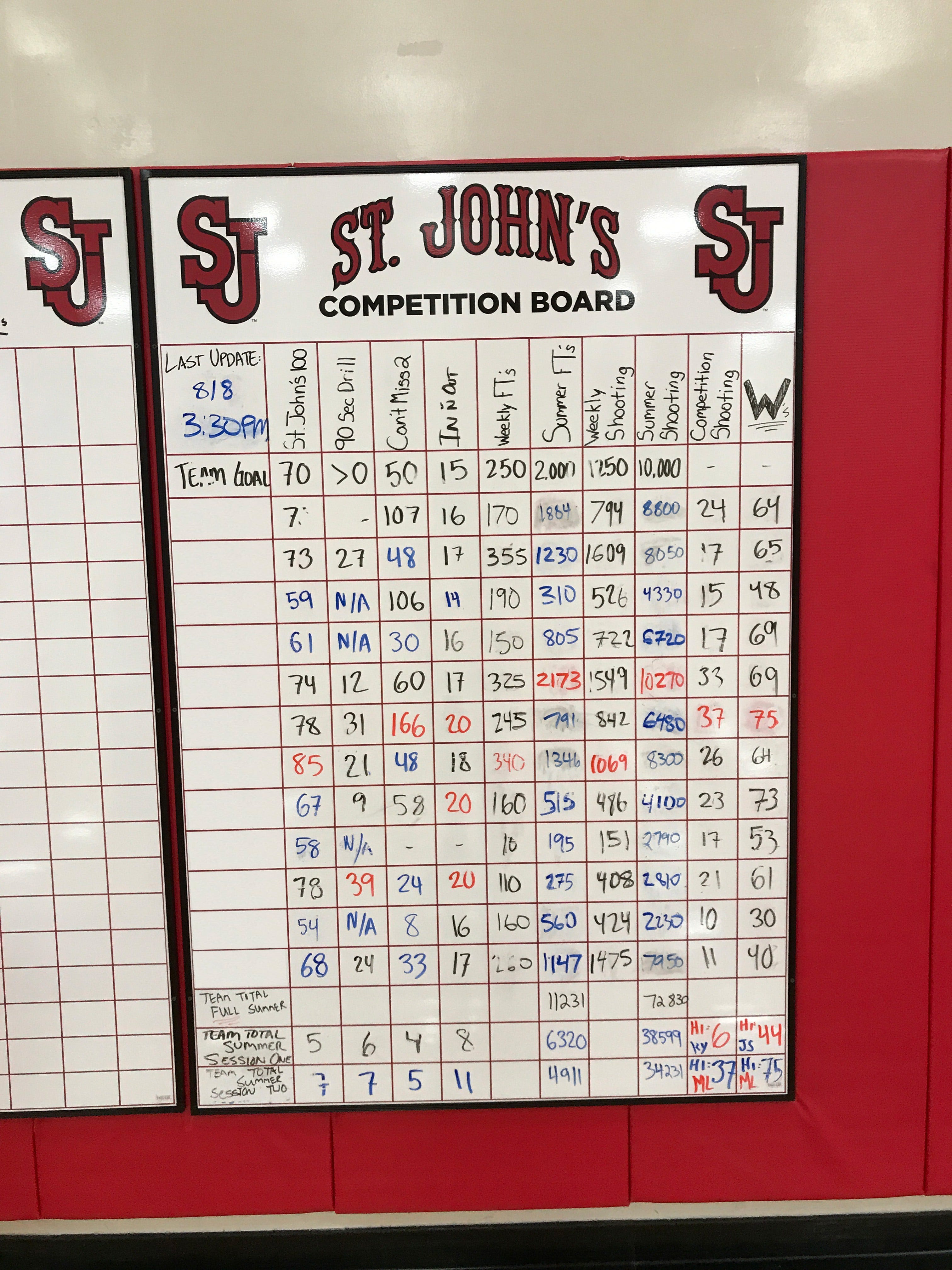
The most interesting thing about the competition board was the effect it had on a handful of players. Amar Alibegović and Bashir Ahmed, both rising seniors at the time, were two players that were completely dedicated to getting extra shots up. These two in particular were extremely competitive in a good way with each other, which was increased when the competition board was added to the gym. If one of them got shots up at 7:00 AM, the other would come in and make more shots at 8:00 AM. After workouts, whoever had been passed by the other would then insist on shooting again to take the lead. Many times, they would get shots up together.
These memories are burned into my mind because most of the time, I was one of a handful of managers there in the summer who had to rebound for them both. It was a weird feeling, simultaneously being happy that our players were working hard while also being exhausted from chasing after rebounds to the point where we could barely move by the end of the day. However, that competitiveness and what spurred it has stuck with me for all of these years.
Shooting = Confidence + Reps
I have always attributed the following quote to Mully. I cannot remember the context it came up in, but it has always made sense to me.
“Shooting is a product of confidence and reps, and you get confidence from reps.”
Mully did not like to alter a player’s shot much, most players that he recruited were players that he believed could shoot to begin with. He would occasionally give some pointers, like encouraging players to use their legs more, but from what I remember, he was a believer in the idea that you do not want players overthinking their shooting form. Some of the best shooters in basketball history had unconventional forms. With enough practice, anyone could become a good shooter. Basketball, more so than any other sport, is a game that is reliant on getting into a rhythm. To get into a rhythm, a player cannot get lost in a cycle of overthinking.
For a similar reason, he believed that you should never tell someone not to shoot. We had one player whose previous coach had been particularly hard on him and told him that he was not allowed to shoot threes under any circumstance. You could tell when he got to campus that he struggled with confidence now that he had been given the green light to shoot when open. Applying that logic to midrange jumpers, at some point in a game, either at the end of the shot clock or at the end of the game, a player will have to shoot a middie. A coach should not want that player to overthink taking the shot that the defense is giving them in that situation, as any shot is better than no shot.
It is very easy as a coach nowadays to put together a video playlist of terrible shot attempts and turnovers, and frankly, it can feel cathartic to play those in a film session and reinforce how bad those decisions were. However, most players in this generation will tune out negativity if it is something they hear on a day-to-day basis and as good as those film sessions may feel in the moment for us coaches, usually they do not have the intended effect.
Points Per Shot
During my first year at North Dakota State, we tracked all practice statistics and charted all shot attempts, and after each practice, I would send out a packet to our staff with the box score from that day, the cumulative box score, the box score from the last five practices, a few team leaderboards on stats like effective field goal percentage, and then a cumulative team shot chart.
Occasionally, Coach Dave Richman would ask me to share the statistics and leaderboards with our guys during film sessions. Richman, like most coaches nowadays, does not like midrange jumpers, but was willing to allow certain players the freedom to take them because they had proven they could make them at a decent clip in games. However, it became hard to convince the other guys on the team to not take middies if a few of their teammates were allowed to take them. There was one film session that comes to mind in 2023, where we only had a few guys above the 50% effective field goal percentage threshold right before the season started, that planted a seed in my head: we needed to fully explain effective field goal percentage and show our players the data more often.
Going into 2024-25, due to a transition to 5 Out, we were planning to play live in summer workouts much more frequently than we had the summer before in an attempt to build chemistry and get our players used to making reads. This also presented an opportunity for a large sample size of practice statistics. I had recently come across Points Per Shot, a statistic that was essentially field goal percentage made more digestible and useful from a teaching perspective. For example:
A Division I team averages around 65% on shots at the rim. This would be 1.3 points per shot (0.65x2)
The best 3 point shooting team in the country shoots 40% from 3. This would be 1.2 points per shot (0.4x3)
The Division I average for 3 point shooting is 33%. This would be 0.99 points per shot (0.33x3)
For a player to be more efficient shooting midrange jumpers than being an average three point shooter, they would have to shoot 50% on middies, which would be 1.0 point per shot.
In this same offseason, we were in the process of going from being a team that would send three to four players back on transition defense to a team that would send three to four players to the offensive glass, a topic that will be expanded upon in the next entry. After each practice, we would go through and chart how many players were correctly executing their transition defense roles on each possession. With the competition board in the back of my mind, we decided to start printing a variety of sheets from our practice statistics spreadsheet and hang them on the board of our locker room. It started with just posting the crashing percentages, but quickly evolved into including other statistics, such as the shot chart data on rim attempts and three pointers, as well as the numbers/records from our standardized shooting drill, Five Minute Shooting.
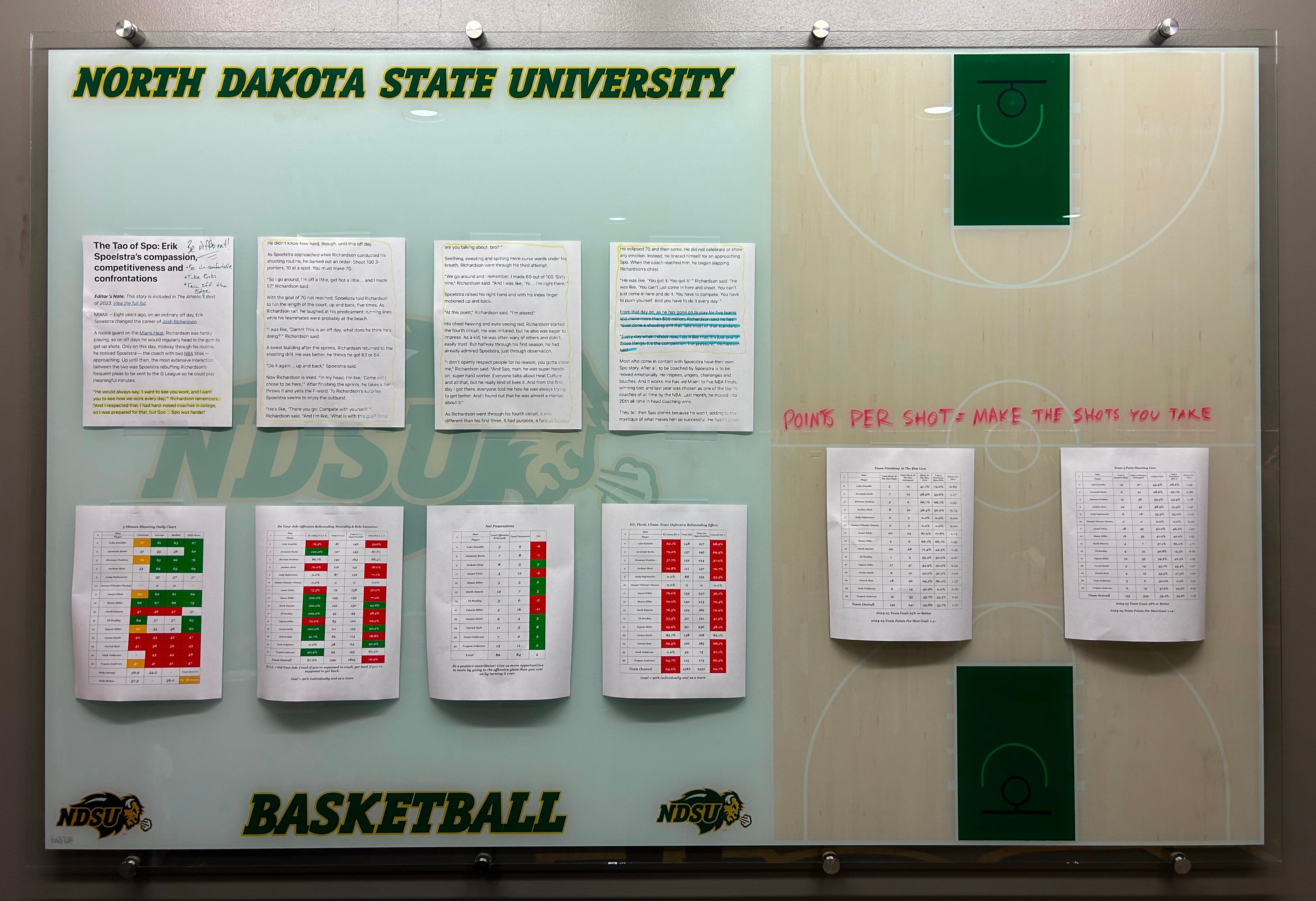
When each sheet was hung up for the first time, I would explain to our players what it meant. The point of only showing the rim attempts and three point attempts was because those are the two shots that have the greatest impact on effective field goal percentage. The theory was that by seeing where they stood in comparison to all of their teammates, players would then focus on improving in these specific areas that they were behind in and that we as a staff cared about. If they were behind on points per shot at the rim, they would work on finishing. If they were behind on three point shooting, they would know exactly how far behind they were and get more shots up on the side. There was no point in showing them the midrange data on a daily basis because we as a staff did not care what players were shooting on midrange jumpers anymore. There would be no more exceptions to the rule. This streamlined approach to sharing statistics proved much more effective than posting a full boxscore.
I wrote POINTS PER SHOT = MAKE THE SHOTS YOU TAKE on the board as a way of explaining to our guys that each shot they take matters and they should be focused on taking the highest percentage shots for them each time they shoot the ball. The coaches are not directly telling a player to shoot any particular shot, but this allows a player to see where they are at every single day and make that decision for themselves. It flips the narrative from “Coach is telling me not to do this,” to, “I have to get better at this or I will not play.”
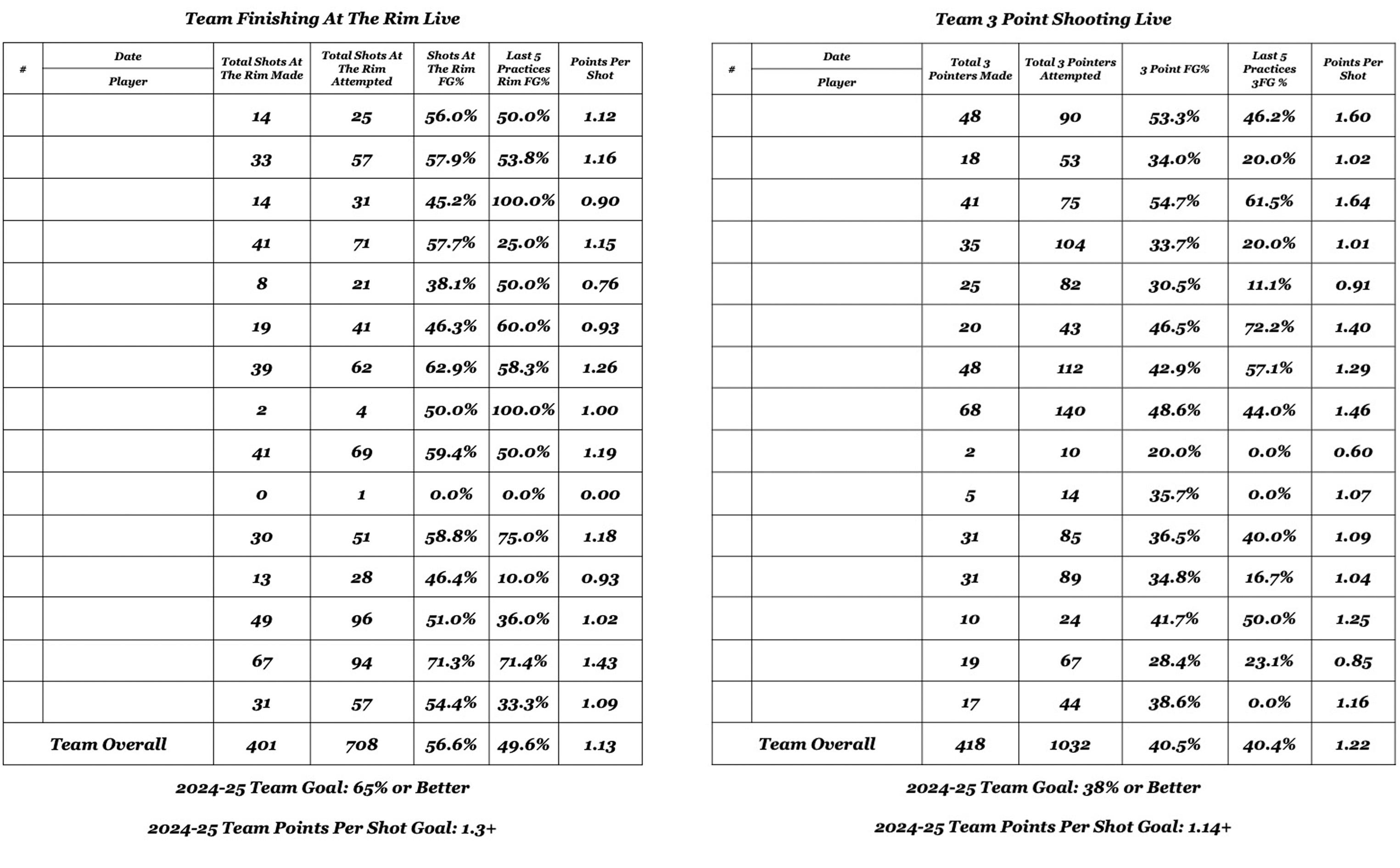
As you can see in the picture of the NDSU board, some of the sheets have green and red highlights for good and bad, but the live shooting charts do not have any highlights. One reason for this is because each player’s strengths are different, and as a result, great cutters and finishers do not need to be better shooters than players who are primarily spot up shooters (and vice versa). Another reason is that players go through hot and cold stretches, and I did not want to compound the negativity a player in a cold stretch is feeling with more negativity. I also did not rank our players on these locker room stat sheets, mostly for the same reason.
Once full practices started in late September, we “reset” the numbers to give players a fresh start once they had gotten used to the ideas we were teaching. The clean slate helped our players see that they were making significant improvements compared to where they were in the summer. Once the season started, we stopped posting statistics on the board.
3-3-1 Scoring
In 2023-24, offensive coordinator Luke Strege instituted a concept for scoring live practice drills called 3-2-1 scoring. In live 4V4 and 5V5 segments of practice, three pointers would be worth three points, layups and dunks would be worth two points, and midrange jumpers would be worth one point. At the end of each live segment, the team that lost would have to run a 17 (17 sideline-to-sideline sprints). This would work as a way of reinforcing the idea that relying on midrange jumpers would be a losing strategy.
In the spring of 2024, when we were spitballing ways to tweak drills and our approach to team-building, I suggested we tweak it to 3-3-1 scoring, since the true points per shot of a layup/dunk compared to a three pointer was closer than 3-2-1 would portray and made the two best types of shots equivalent as winning shots. The difference in reward for hitting a step-back midrange jumper would be drastic compared to the reward for driving and either finishing at the rim or finding an open teammate for a three.
Reinforce The Good
Following up on what I mentioned earlier about video, it is important to be wary of what you show college players in film. Coach Strege insists on not showing misses during offensive film sessions. If there is a great offensive possession that happens to end on a miss, he would end the clip when the ball is about to hit the rim. The players will learn that it indicates a miss, but they still would not see the miss themselves and the focus is on the action before, rather than the result.
Basketball is a game of rhythm, feel, and energy. If players are feeling good about their play, you want to reinforce that and keep it going as long as possible. If players are in a funk offensively, you want to remind them of what their good offense looks like.
This past season at Cal Lutheran, we started out 8-5, playing solid defensively but struggling to shoot the ball. After two straight seasons ranked in the Top 25, two regular season titles, and nine seniors graduating, there were some real growing pains for a young group still figuring out who the leaders on the court were. In the beginning of the season, at full strength, we had played a few good offensive games in Marietta, OH during an MTE, but otherwise had been pretty stagnant at times and could not find our shooting rhythm. We had a five game stretch in January over 11 days where we were without a healthy point guard on the roster, played two teams ranked nationally in the Top 15, as well as two road games against teams that would finish above us in the league standings. Towards the end of that stretch, head coach Russell White went back and watched the two games from Marietta and was amazed at how different our team looked offensively. Our cutting was better, we were moving the ball more, we were attacking the rim consistently and not settling for poor shots, and overall looked like a completely different group.
I went back as well and pulled positive clips from those games, and instead of dwelling on recent performances, we showed our players what they looked like at their best. We made it a point of emphasis to only show positive offensive clips over the rest of the season. Below is a graph illustrating the offensive differences between each part of the season.
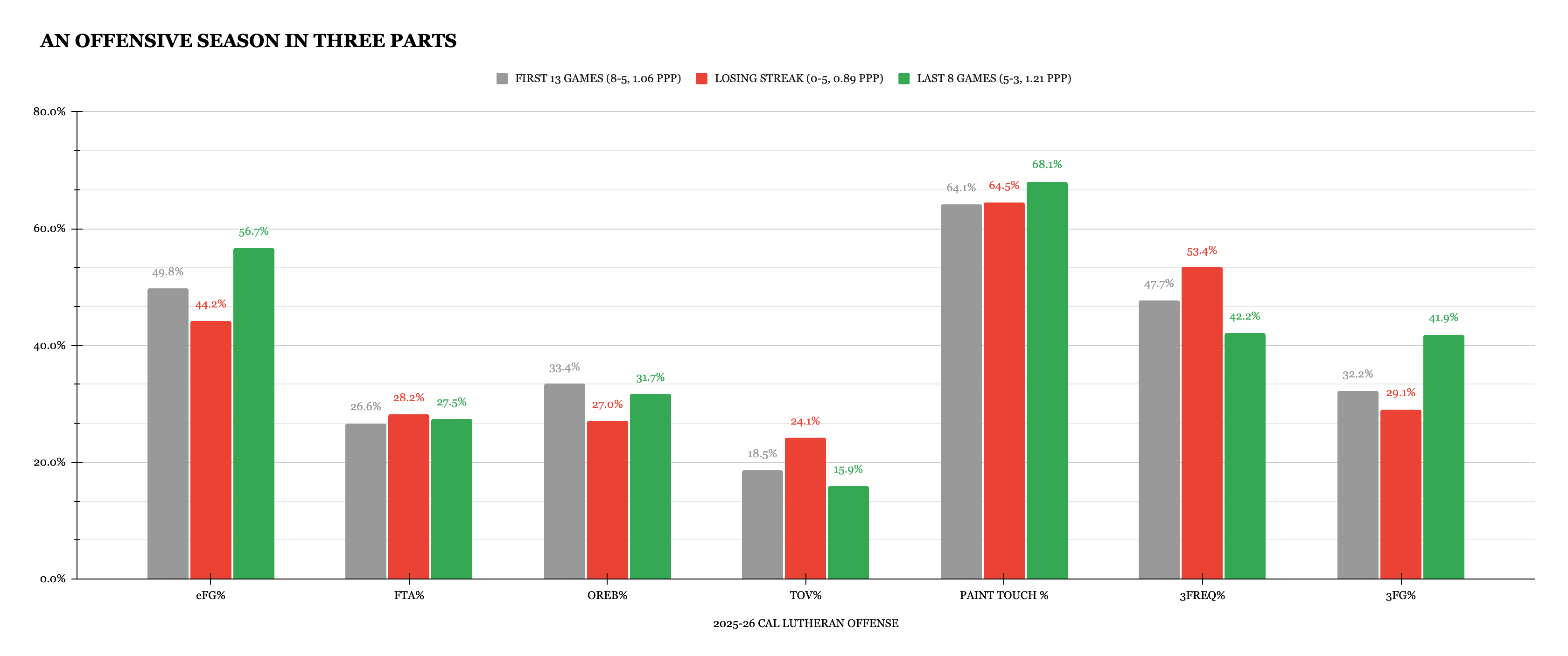
As shown in the graph, over the last eight games, we averaged 1.21 points per possession, had a 56.7% effective field goal percentage, and shot 41.9% from 3, significant improvements from the previous 18 games and a taste of what this group could be during the 2026-27 season.
“Help us win so you can get paid.”
All of the above topics and ideas are teaching points and ways to approach the mentality behind shot selection, but the greatest motivator, especially in the Name, Image & Likeness era, is money. The best advertisement that North Dakota State basketball ever got was Grant Nelson starring for Alabama on the way to a Final Four appearance in 2023-24. In every game that the Crimson Tide played during the 2024 NCAA Tournament, there were at least a few references to Nelson’s time in Fargo playing for Coach Richman.
This has been an uncomfortable topic for mid-major coaches over the past five seasons, but as the money at the highest levels of the sport has grown exponentially, the more it has become unavoidable and just a fact that needs to be discussed. Mostly gone are the days of players staying at one school for four seasons. Now, there has been a pivot to the mindset of, “How do we retain players for as long as possible?”
Externally, to fans and journalists as well as to administrators, coaches are judged on wins, losses, and NCAA tournament appearances. But within basketball, coaches have also been judged also on how many players end up playing professionally. Now, mid-major coaches are also judged on how many of their players end up signing large NIL deals with power conference schools. As a coach at that level, you have two options: lean into it, be upfront and honest with your players about the landscape, and help them reach the next level; or ignore the elephant in the room.
As a credit to Coach Richman, the Bison have leaned into the former over the last several seasons. When discussing shot selection, other statistics, and their importance with our players, I was given room to speak freely about what NBA/overseas scouts were looking at, how power conference coaches looked for transfers, and explain why each player should care about their statistics within the big picture of what we were trying to accomplish as a team.
There is something to be said for being honest with players from the start and the trust that honesty builds with players. A player understands where you are at, they understand the decisions you are making and why you are making them, and as a result, they trust that you have their best interests at heart. While I would stop short of banking on that trust to be enough to negate hundreds of thousands or millions of dollars being offered in the portal, I would say that trust certainly helps retain players when the money is close enough, or good enough in the short term. It can be enough to sway a promising sophomore from testing the portal before his junior season, if they know they will have a big enough role to command significantly more money after the following season.
The title of this section is a direct quote from an NBA coaching clinic. That message is incredibly relevant to mid-major hoops right now.
It can be tweaked and applied to each level of basketball. If you are a high school or JUCO coach, this message is already familiar to you. Good players slip through the cracks to Division II and Division III on a regular basis. Cedric Coward averaged 20 points per game as a freshman at Willamette (DIII), transferred to Eastern Washington for two seasons, went with head coach David Riley to Washington State for his senior season, and got drafted with the 11th pick in the 2025 NBA Draft. AJ Rohosy spent two seasons as a walk-on for Kyle Smith at Washington State, transferred to Claremont-Mudd-Scripps (DIII) for a season where he went on to become an All-American, and transferred to Stanford to start for Smith in the ACC during his senior season. Bennett Stirtz developed under Ben McCollum at Northwest Missouri State (DII), Drake, and Iowa before getting drafted 16th overall in this June’s NBA Draft. Closer to home, Jacksen Moni spent three seasons developing at Northern State (DII) before he came to North Dakota State and fully blossomed into being at least an NBA G-League player.
The routes look different but the point remains the same: buy into our culture and what we are teaching, help us win, and the rest will take care of itself.
When All Else Fails
Occasionally there will be a need for individual meetings. In October 2024, Damari Wheeler-Thomas decided to use a medical redshirt due to lingering injury issues, with the belief that a year without the mileage of playing games would help him finally fully recover.
Damari is a coach’s dream. He watches film on Synergy regularly on his own, lives in the gym, takes pride in defense and hustle stats, and is an incredible locker room presence. His shot selection was the one area we struggled with at times. Damari would go on to lead the 2025-26 Bison in scoring, and early in his career, was known for loving the midrange jumper.
Shortly after Damari decided to redshirt, I pulled him into our conference room to show him our more detailed internal leaderboards and some film. He was towards the bottom of our effective field goal percentage leaderboard in practice at the time. While I was not showing the whole team their midrange jumper data, I showed Damari that he was shooting significantly worse on middies than he had at the same point the previous year in practice, and was taking significantly more of them than any of his teammates. Due to transitioning to 5 Out instead of having a traditional big on the block, our spacing was much better and the rim was much more open than it had been in previous years. If he could keep driving to finish or distribute instead of settling for middies, or just catch and shoot for a three instead of ripping right to get to his spot as often as he was at the time, his numbers could be way better.
Damari would later tell me that seeing his name towards the bottom of the overall effective field goal percentage leaderboard made it all click, and over the next few weeks, he became much more conscious of his shot selection. He steadily climbed the leaderboard, and spent his redshirt year working on his three point shooting. Damari went from shooting 1.6 three pointers a game at a 36.9% clip in 2023-24 to shooting 5.9 three pointers a game at a 38.3% clip in 2025-26. His eFG% climbed to 50.7%, the best of his career so far, on the way to All-Summit 2nd Team and Summit League Tournament MVP. He will suit up for the Boise State Broncos for his senior season. Damari still takes midrange jumpers, but he understands the math and pick his spots.
Bringing It All Together
Many coaches are hesitant to overload players with data and information, and for good reason. As discussed above, basketball and overthinking do not mesh well together. However, there are ways to simplify the message and use statistics as teaching points. College coaches generally recruit players that they believe are good enough shooters, are competitive, and are coachable. With those expectations in mind, do not be afraid to challenge players up and throw big ideas and concepts at them. Graphs, charts, and numbers can be intimidating, but everybody understands that 1.3 is a higher number than 0.8. Explain and show the why behind everything.
For non-Division I programs, it will be hard to go as in depth with shot charts if you do not have the manpower to chart on a daily basis. The Division III preseason is much shorter without summer workouts, but when it starts, it is busier than a Division I preseason due to no hour limits. This took some getting used to last fall when we got started at Cal Lutheran, as our first workout was on September 29th. Our schedule was full of two-a-days, and we were lucky enough to have a few volunteer assistants and a couple of managers to help live-stat practice. Having the experience of what last preseason was like will help with coming up with ways to tweak things this preseason.
Beyond the numbers, keeping players in a positive headspace is incredibly important. Next play, next thing, next shot, do not dwell on whether the ball goes in or not. Positively reinforce the on-court behavior you want to see, and trust your process.
None of the ideas discussed above are brand new or program-altering for anybody. Coach Richman would say that a big reason these ideas were accepted and ended up working was because they were not radical changes to anything that we were doing at North Dakota State. These ideas complemented the existing culture and structure that was in place. These were simply new ways of teaching and articulating points that we were trying to make, and our players bought into it. The Bison KenPom page may look different, but the practices do not.
A special thanks to coaches Dave Richman and Russell White, for giving me permission to start this project and talk about the Bison and Kingsmen programs. Thanks also go out to Damari Wheeler-Thomas for allowing me to use his story as an example. And of course, thanks to Chris Mullin and his staff for starting this coaching journey for me almost ten years ago.